
Tragedy

My biggest worry is that the whole world is turning to news for salvation. That news has become our primary strategy for spiritual survival. The news cycle is daily pronouncement of catastrophe and has kind of been so (in varying measures) ever since the inception of the printed newspaper. The news industry brings stories from across the world, near and far, that alarm us and cause us to look at the world in shock and awe. It collapses distance and turns the unknown into an interesting, if horrific, story.
In the last couple of years, the world has routinely stomached the most horrific audiovisual material coming from Ukraine and Palestine, and come up with reasonable responses of horror and outrage about the current moment. Concomitantly, we have forgotten that the news cycle in the 1980s and 90s returned every morning (in paper forms or TV/radio rather than the invitation to click on internet) with news of carnage and death in Bosnia-Herzegovina, Kuwait, Iraq, Libya, Afghanistan to name just a few. The news has been numbing us for a long time now, providing inoculation against the actuality of the horrors of the world. Watching the Netflix show Kohrra about crime and social life in contemporary Punjab the past few days (stellar performances by Mona Singh and Barun Sobti in Season 2), I realized the passing reference to disappearance cases of the early 90s (both in Kashmir and Punjab) used to be regular stuff of the news. The realness of past horrors fades with time. Young folk today who are live to the violences of contemporary India have meagre memory of the age of disappearances in the 80s and 90s, even if they are from those regions, unless, as we see in Kohrra, the reality lives on in families who lost members in such news cycle events. The news is real, for some. Those who become statistics in news archives, know something about the news that readers of news websites or social media soundbytes will not understand. Somewhere a building is burnt, a daughter has died a dowry death, a child has starved, a homeless person has dies of frostbite, and a son lost in a disappearance case while the mother lives on with a bag of papers. All of them have equal valence in personal tragedy.
The news further serves as an emotion-dialling device (ranging from outrage, shock, guilt, horror, shame) for readers of the story. We forget that when we read daily titbits about horrifying events that are not in our backgarden. We begin to claim these soundbytes or fragmentary stories as our own things - to lace our own naratives with.
The Greeks had a different way of getting at bad news. They would ask the question: why did this ‘bad thing’ happen, and why did it happen to this particular person? It was, among the Greeks, a diagnosis of the will of the Gods, but also a way of stomaching of the terribleness of the world for the audience that came to watch and experience tragedy as theatre. Two feelings were publicly acknowledged by the Greek audience: 1) thank god, this did not happen to me (fear), 2) the sensation of pity for the character upon whom terrible tragedies have fallen (pity). The Greek audience was honest and forthright enough to experience Katharsis, a manner of cleansing of the soul through the washing of these emotions of pity and fear, by never asking how they themselves could go about setting things right. This was partly because they were believers and they believed that these things involved Gods’ will, and that the actions of men were merely instruments. Secondly, they had a less dramatic and egotistic view of their individual role or power in the making and unmaking of the world. The calls for action (like in Krishna’s edict to Arjun on the battlefield of Kurukshetra asking him to kill brothers and cousins in the war, knowing fully well there will be no winners in such ensuing destruction of which he would be a primary author) must come upon the consideration of what a legal scholar friend calls the ‘jurisprudence of dilemma’. Simply stomaching routine stories of ‘bad things’ cannot be the most legitimate format of moral pedagogy. There are no winners in the world.
I write this not quite to invite the contemporary audience of news to become an audience of theatricised tragedy, but to venture the thought that apportionment of blame may not be the only response to the routine reading and interpretation of tragic information that we digest along with morning coffee. The stomaching of tragic news demands of us something of the actualisation of an emotional formula. Some would say that emotion is a resource for productive action against the villains of the world, and I wouldn’t entirely disagree. But first, let us be a bit more honest, like the ancient Greeks, and admit to ourselves what work the news industry does for our strategies of spiritual survival.
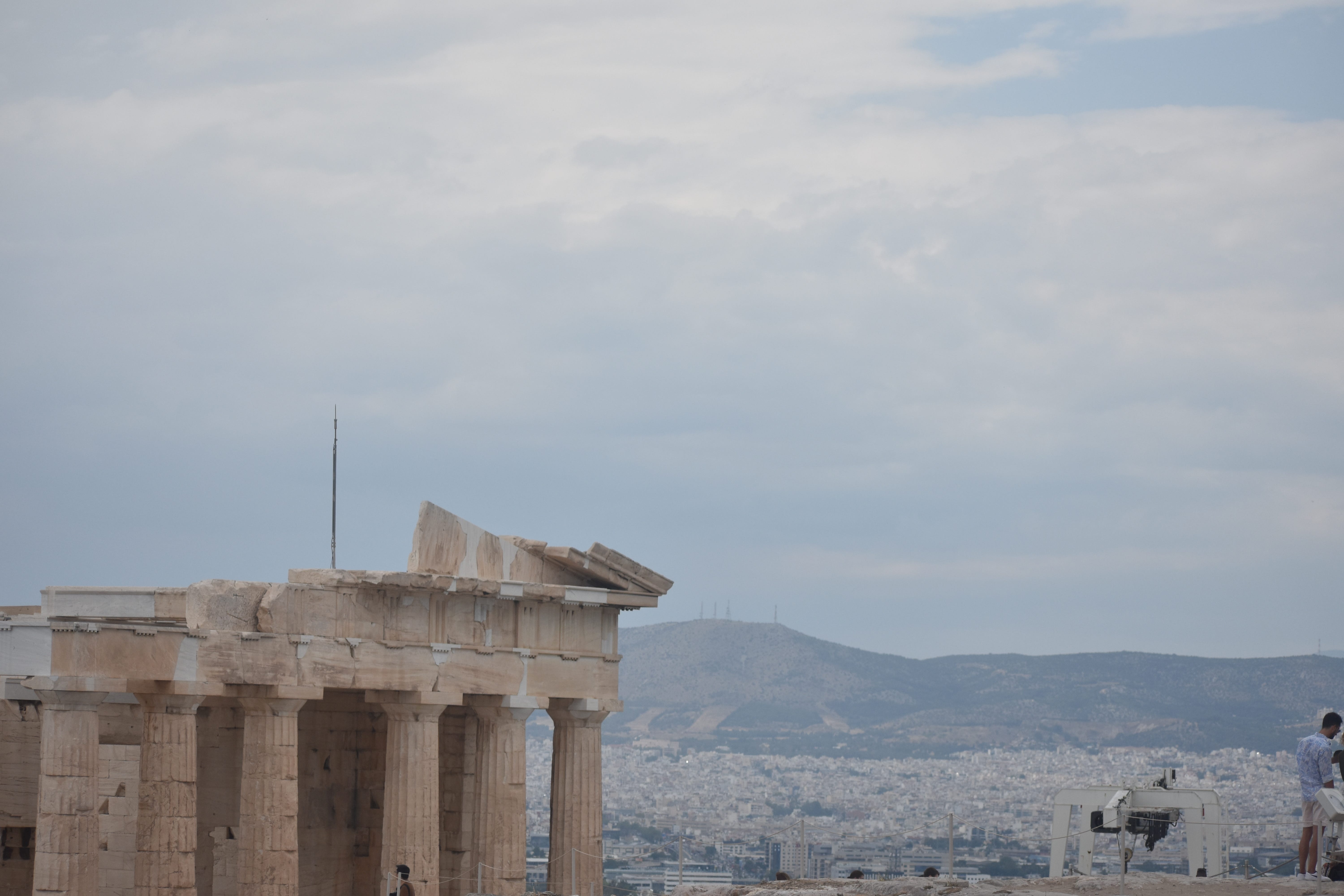
[Parthenon in repair. Athens, 2023. Copyright: Atreyee Majumder.]