
Secret

At the end of the year, I find myself opening S Radhakrishnan’s The Principal Upanisads (HarperCollins 2024; first published in 1953). It is a masterful collection of notes, commentary, and translations of this ensemble of texts that go by the name Vedanta or the Upanisads. He says (p.24) that the Samhitas and Brahmanas are the hymns and liturgical books and represent the ritual part of things, while the Upanisads represent the jnana-kanda or the knowledge part of things. He further says (p.24): “ The Upanisads describe to us the life of spirit, the same yesterday, today and for ever.” Nitya, eternal, timeless. The Upanisads are often described as carriers of secret knowledge. Patrick Olivelle also stresses on this. Secrets that must be handled carefully, passed on to correct inheritors, in reticence and quiet speech. They must be held within the right kind of life - right sounds and apt pauses.
These texts, now codified, and surrounded by commentary, are “vehicles of spiritual illumination than of systematic reflection” (p. 23). There are ten prinicipal Upanisads (p.21) though the actual number runs into somewhere between 100 and 200. Among these are Aitareya, Taittiriya, Chandogya, Brahadaranyaka, Isa, Katha, Kena, Mundaka, Prasna. They refuse the question of contemporaneity or timeliness. They refuse the proposition that texts belong to the times of their origin - in which they are spoken and/or written. They invite me into their worlds and folds - as if giving a call. In sacred geographies across the world, the talk of a call to walk out of households and accept asceticism or mysticism, is very common. The results are diverse, as I saw in Vrindavan. Some take to temples and orders, other lie by the ghats, others sing, yet others return. There is no formulaic route to answering this cosmic interpellation, I believe.
What use is all this? As my students would often ask. Will it improve governance? Stop wars? Convert fire into water? Reverse climate change? Bring up old utopias or build new ones? My answer is limited. I can only examine and contain the tendencies of inner violence that I (and we) harbour, which may be a worthy starting point. The war without is a version of the war within. There is no clear distinction between inside and outside.
We are individually at war. I watched the third film in the Avatar francise this weekend. The children of the Navi grow up and into the war between good and evil. They accept as one of their own, Spider, an alien, a child of the enemy. Therein, lies greatness.
Wishing you fire and water in the perfect combination. Wishing you rest, stillness, ever so brief respite from the relentless motion of the world, and wishing you now and always, the residence of God.
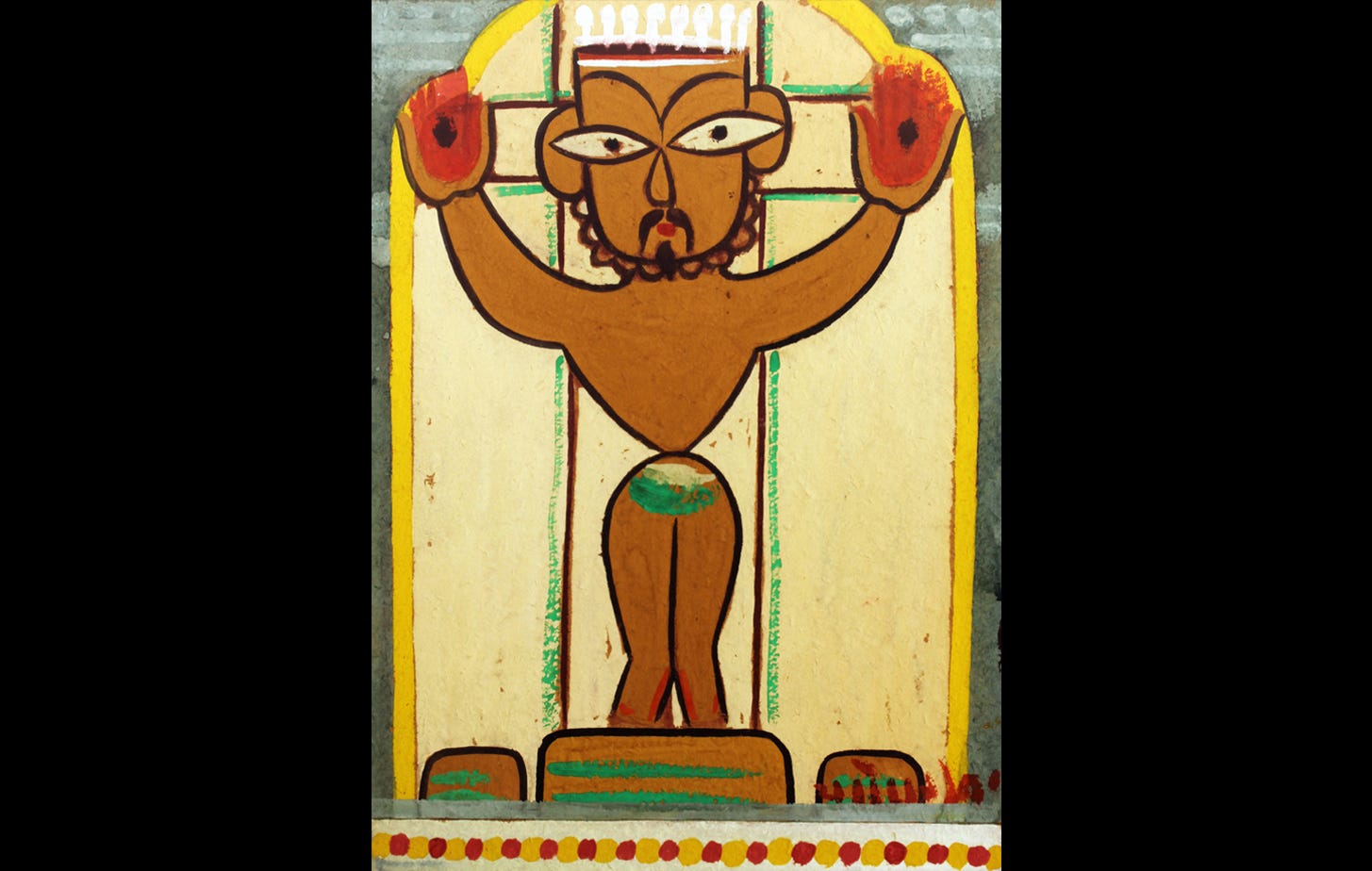
[Jamini Roy. Crucifixion (undated). Image courtesy of WikiArt.]