
If, spring
Chronicles of a craving for North India

I am back in Brajland. Those of you who read this newsletter somewhat continuously, will know I spent part of 2024 in Uttar Pradesh, in the region popularly known as Braj, the sacred geography of Krishna worship. A film-maker friend and I were out and about yesterday, and finally decided we shouldn’t try to reach our destination (we were invited to a private Holi ceremony) because of the tumultuous Holi celebrations on the streets, and came back home. Fully drenched and defeated. I thought about our defeat the whole day. I missed out on precious musical performances that were being performed at various locations. We missed out on important visual recording opportunities. All kinds of usual racist criticisms of north India and its masculine protocols were coming to my mind. It is not difficult to resort to “hate” or “strong dislike” when one’s own freedom is dramatically curbed; appreciation of another’s culture is not as easy in practice as us liberals make it out to be.
And then, in the evening, I watched Achal Mishra’s (I had thoroughly enjoyed Mishra’s previous films Dhuin and Gamak Ghar) new cinematic offering: Chaar Phool Hain aur Duniya Hain (2025). It is a portrait of the maestro of Hindi literature, Vinod Kumar Shukla. Shukla speaks slowly, in an exquisite Hindi. I yearn to hear his language in all its tones - complete with its lilt, its subtleties, its quiet contemplation. He describes his writing process, his relationship with writing and the world at large. His grandson, who serves as a sort of typist-manager-support-system to the aged writer also speaks. Lights plays in the background. A bird dances delicately on leaves. Shukla’s house is a simple, north India household, the kind one read about in Vikram Seth’s A Suitable Boy in a province of India that was called the United Provinces. This very land. It is today, Uttar Pradesh. The heart of Krishna worship cultures, Dhrupad music, excellent pani puri and samosa and lassi and pedha. And an exquisite language - a mix of Hindi, Khari boli, and Brajbhasha. It is also the place of an aggressive masculine culture. This contradiction is unavoidable. Like the contradiction that Marxist, Progressive Bengalis are mostly casteist (not knowing that inter-mingling among the upper caste brackets doesn’t quite liberate them).
But I am inordinately attracted to this land. Where people see, eat, feel, touch Krishna everywhere. It sensuality cannot be denied under any circumstances. Its aggression too. The two are inextricably intertwined. The pekhawaj plays its slow, deep, haunting sound at temples here. And the octopad plays its vulgarity in hedonism-events at night. I go to sleep repeating Shukla’s words: “By others, I don’t mean strangers. I mean someone besides you.” Outside the heaving public dances to the beats of the Octopad, in the land of the pekhawaj.
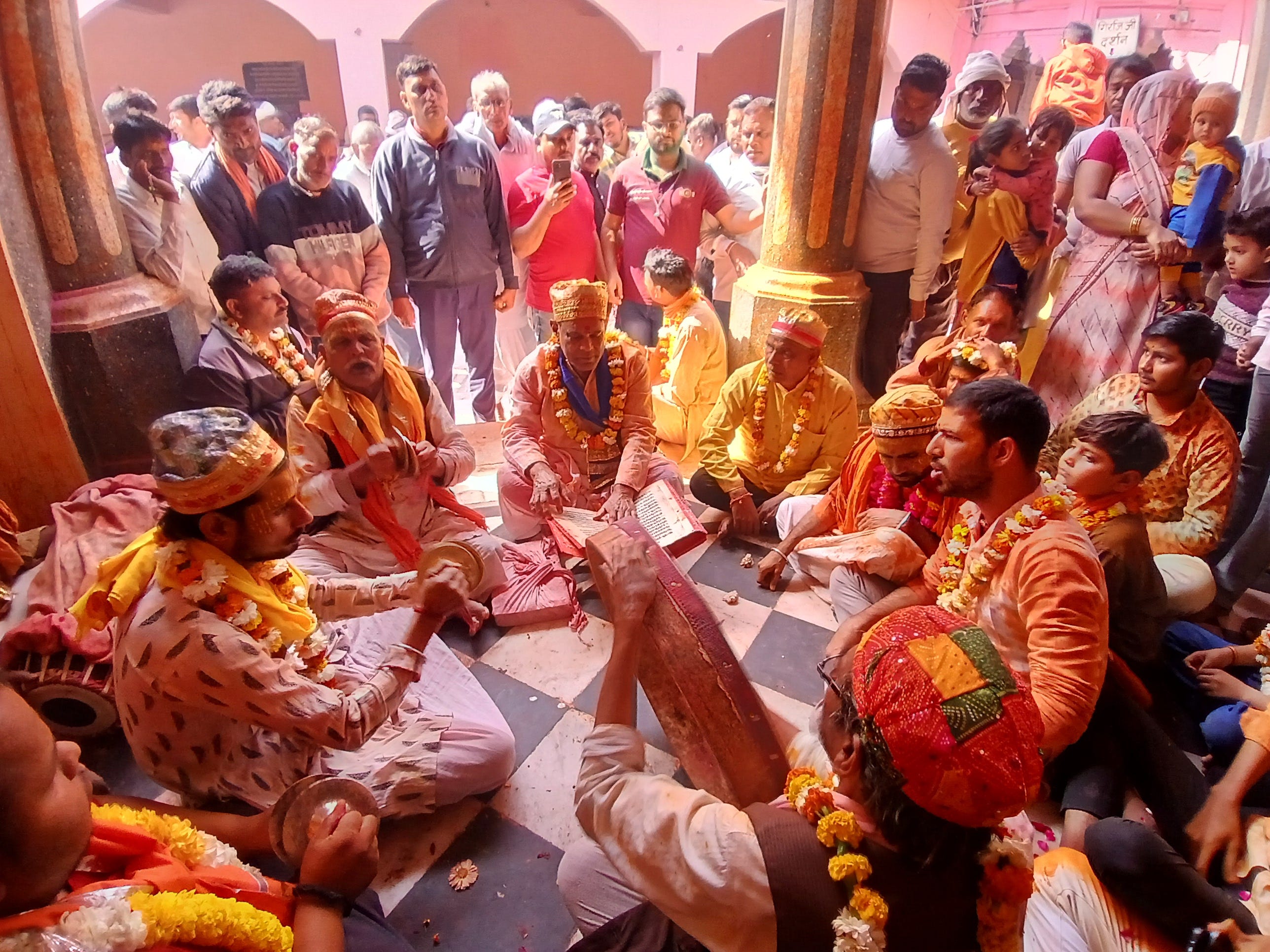
[Holi in Braj, 2025. A musical performance at a noted temple.]