
Dark Pleasures

I spent the weekend chasing fauna at a National Park close to Bangalore, and had two tiger sightings on two consecutive days. I have had similar luck at another National Park too, a couple of years ago. Tigers have shown up sometimes at a distance and sometimes within two feet of my body. This is thrilling not only because of the tiger’s awesome beauty, sharp eyes, and steadfast gait, but because time stops with closeness to the tiger. You are a shred of time away from the immediate possibility. That is what I learn from the tiger each time - that the possibility of death in the immediate timeframe, is just that, thrilling. A dark pleasure. In a way that spotting birds and otters and wild dogs and the barking deer are all pleasurable but don’t quite hit the spot.
Having narrated the predictable anecdotal entyrpoint, let me come abruptly to the question of attacking the self - that old, tried and tested, dark pleasure. Which, I think, is what we desire everyday and the tiger enables effortlessly. It is also, I think, what enables literature. To see one’s self at the verge of attack, shattering the sociological stability built within it. What if? - says the novelist. What if? - says the ethnographer, pushing the limits of their sensory self and shoves a mic into another person’s face, and asks “what if I were you?”
What use is ‘memory”? Asked the actor/director/art curator Oroon Das on a brief zoom call. The very next morning, Annie Ernaux showed up on my screen, with the words (in the essay “ The Transpersonal I”:
Naturally, if he referred to a real person, it had to be the same for I. Any ambiguity would have robbed the book of its purpose. I included myself in the text as a daughter who shared the same world as my father, a labourer turned shopkeeper, and as a narrator, a professor who had moved into the world of “legitimate” speech. An in-between space, a real distance that the text exposes, which it is impossible to conceal, because in a book like this narrator’s social, cultural, and position is essential.
Thus my transition from fictitious I to a real I is not due to a need to lift the mask but related to a new writing project that I define in A Woman’s Story[4] as “something between literature, sociology and history.” By this I mean that I seek to make concrete, by using rigorous means, “lived” experience, without abandoning what makes the specificity of literature, namely the requirement to write well, the absolute commitment of the subject in the text. It also means, of course, that I reject belonging to a specific genre, be it novel or even autobiography. Autofiction doesn’t suit me either. The I that I use seems to me an impersonal form, barely gendered, sometimes even a word belonging more to “the other” than to “me”: a transpersonal form, in short. It’s not a way of building an identity for myself, through a text, of autofictionalizing myself, but a way of grasping, within my experience, the signs of a family, social or passionate reality. I believe that the two approaches, really, are diametrically opposed.
To write literature is to savour an obvious dark pleasure that hangs on to the safety of the “real” by a strong tether of “memory”. That is why Memory is useful, I think, Annie Ernaux would say to Oroon in a defence of the last tether against the trapeze swing into dark pleasure. Your mind is still strung along those two two ropes of memory. You are real, it says, you are real.
How much we want to die and come back to visit our own funerals?! The tiger is a reminder of that we want to savour the darkness of the death-wish, all the while a bell that may ring from memory at any time to bring us out of its hypnosis.
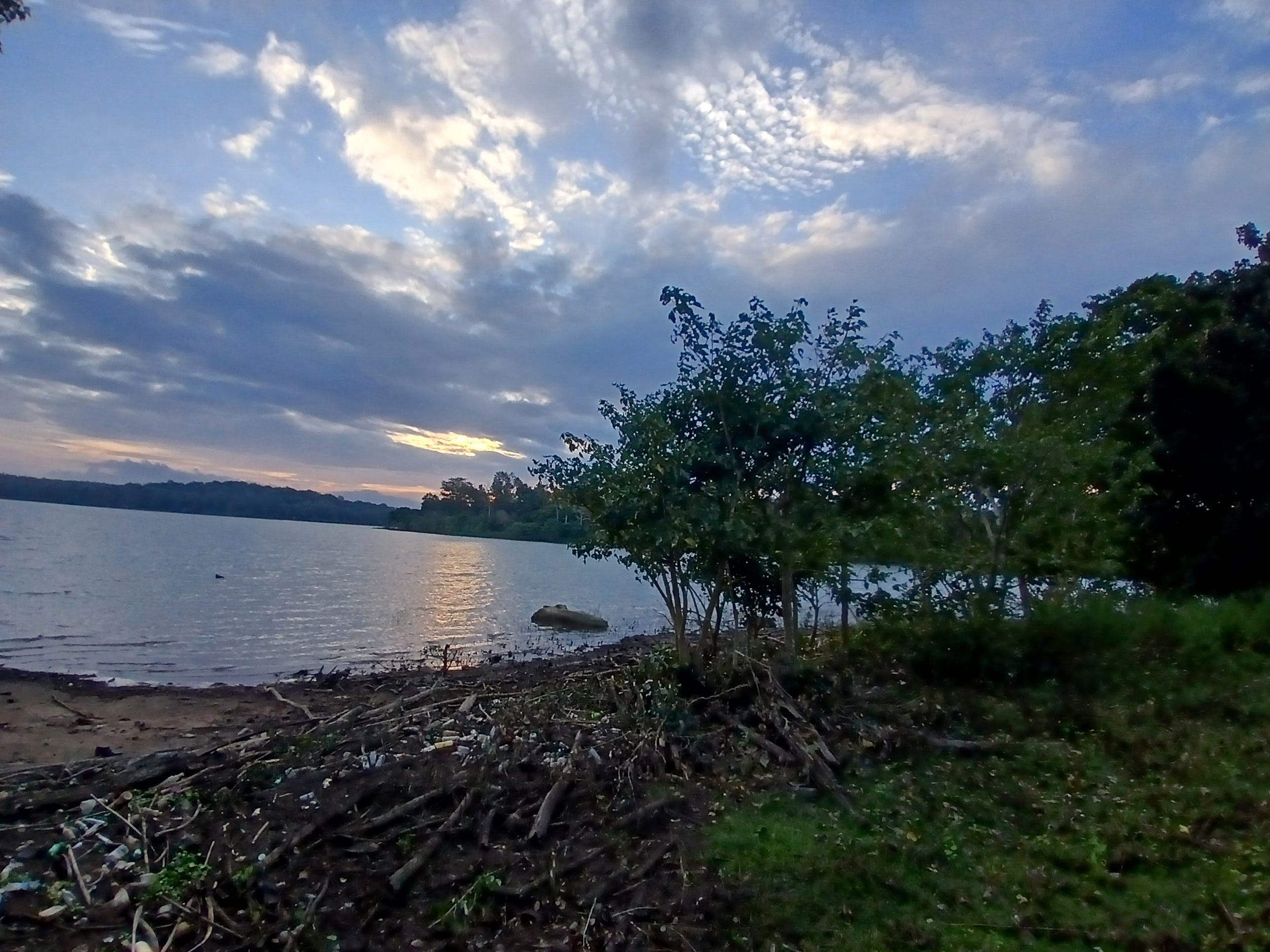
[Marshland by the Kabini River. 20 September 2025. Copyright: Atreyee Majumder.]