
Besant
the nostalgia of spring

Spring is a metaphor for jokes in the modern Indian climatic palette. Winter here jumps straight into the cauldron of summer. But in the Krishna- worshipping imagination, spring is a time of ochre and amber hinting at deep desire - when all of Braj dances to the dulcet tones of Holi. And Radha turns yellow in the tone of longing/separation - biraha. The first song I learnt in my sojourns in the Braj region was by Surdas. It begins thus:
neh lagyo mero shyam sunder son/Aayo basant sab hi ban phoolein/khetan phoolein sarson/Main piri bhai piya ke biraha son/ nikasata prana adhar so.
In all of the fulsome forests and blooming mustard fields of the time of besant, Radha grows yellow with the pangs of separation. Her life flows out of her lips as she roams the alleys of Mathura - a madwoman.
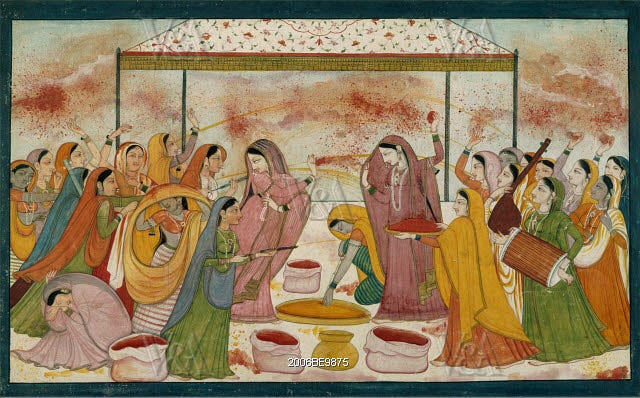
[18th c. Kangra valley painting of Holi being played by Radha. Image courtesy of Victoria and Albert Museum]
A tragicomic time - this besant. There is something comic about happiness. Happiness comes out of the brimming of satisfaction-chai in an equilibrium of circumstance-saucers. What nice weather! What a beautiful lover I have! And now let’s pour all that chai by accident or intention out of the saucer. The real drama begins then. The saucer remains permanently marked by the memory of chai. And our hearts chequered with the cris-cross routes of having trickled out of various vestibules of desire. And Radha doesn’t seem to mind - she walks the alleyways as always, a woman of biraha, a madwoman. Krishna’s absence is more important in this story than his presence. The absence of spring, the grey shadow of the nostalgia of spring, are perhaps more remarkable than the actual playing out of the comical happiness of spring.