
Akam/Puram
What is the "anthropological"?

What is the anthropological? I asked, while facilitating a workshop on ethnographic poetry recently. I was a bit troubled that the external world was routinely being seen as a set of objects and creatures that constitute the “world” - the primary subject of the Anthropological Attention - while the self remained solely the subject of interiority, dominated by thoughts and feelings.
In an essay titled “Where Mirrors are Windows”, A K Ramanujan unpacks the Tamil language distinction between akam and puram (interior/exterior, literally) domains that feature in parallel in Ramanujan’s work – the akam denoting a mood of ‘inwardness’, and the puram signifies the exterior perspectives over the world at large as available to the senses. The world expands, for me and I dare say, for AKR, as a spread of the consciousness where rivers and roads and buildings are but extensions and dramatisations of the interior. Akam-ness and Puram-ness of poems mirror each other, Ramanujan points out (Ramanujan 1999, 15). So outside, in the world of business and intellect, we speak “English”, and in our dreams, we speak Bengali, Tamil, Punjabi, or images, sounds, textures.
I am trying to parse apart the akam/puram dimensions in English language bhakti poetry. I ask: How does the language of colonial rule and postcolonial modernity come to wrap itself around the inwardness/outwardness dimensions of bhakti poetry? Can bhakti be expressed in the English language? Can English become an effective vessel for the force of such extreme devotion in the way that Indian languages have over the past two millenia? My search stems from the personal and intellectual search for contemporary, Anglophone registers of expression of bhakti. Can foreign worlds render intimate meaning? Can they rise out of their imprisonment in the worlds of general knowledge?
I learnt Bhakti in English, first and foremost. In August 2013, I wrote a bilingual poem amidst the onset of psychosis and the last leg of dissertation writing. I hallucinated about a medieval figure replete with cape and walking stick and lantern. He had come to set me free. I wrote (it was unpublished until 2024 when my first book of poems The Book of Blue carried it):
Abraham came to my door.
I listened.
And I listened.
For his knocks.
Three knocks.
Abraham came for me.
With a lantern.
And stick.
A cellphone?
And a shuffle
It was time.
So I was ready.
With two grains.
An empty jar.
And a ziplock bag.
And men walk along
Into the woods.
Walk past Abraham.
His cape.
And his lantern.
Abraham eshichhilo amar dore.
ek noy teen bar toka mere
Aekhoni shomoy bodh hoy
Godhuli sheshe
Flyover-e
Abraham eshechhilo amar dore.
My first figure of awe and enchantment was from the Semitic canon. I like to think Abraham had to grow out of the prison of his cultural and religious context and stretch himself to reach my consciousness, where Krishna was waiting quietly in the backstage.
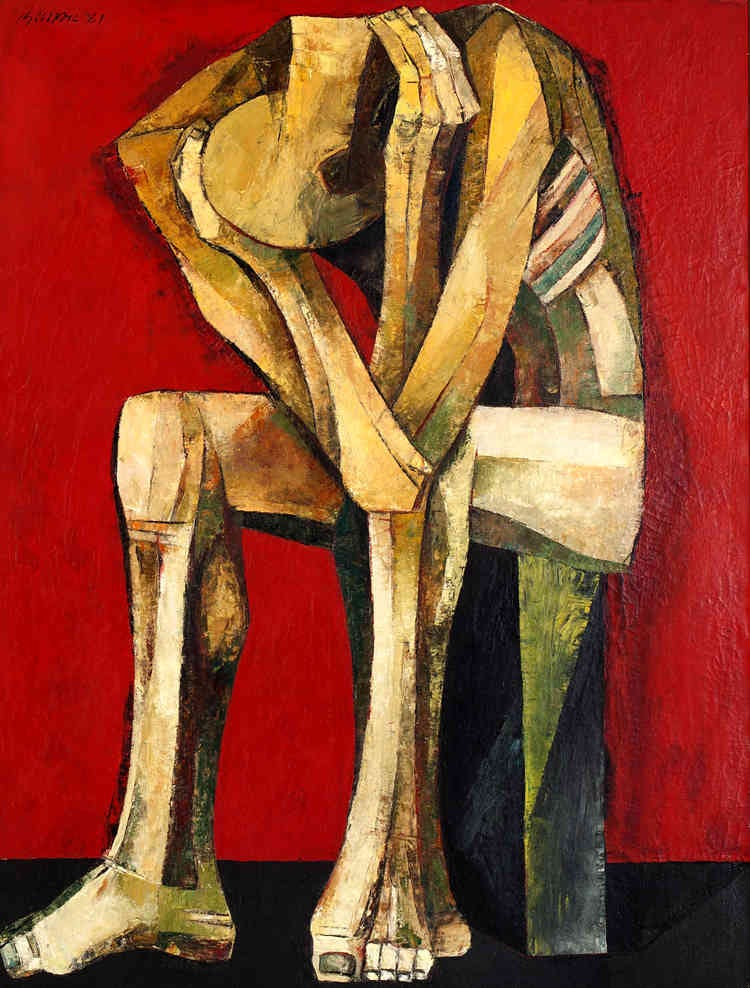
[Thinking Man. Ang Kiukok. Image accessed from WikiArt.]